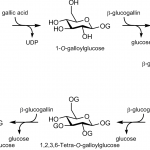
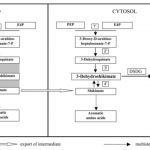
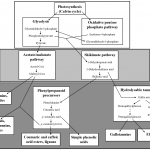
In contrast to the rather limited distribution of gallotannins in nature, ellagitannins are typical constituents of many plant families, but only two steps of their biosynthesis are characterized by enzyme studies To date, over 500 structurally characterised ETs have been identified. This structural diversity is a consequence of the almost inexhaustible number of combinations and […]
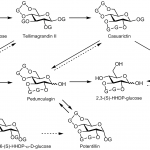
Category Archives: Tannin Biosynthesis featured
Galloylglucose and Gallotannin Biosynthesis
The biosynthetic pathways of galloylglucoses and gallotannins are well-known due to the work by Georg G. Gross and collaborators in the 1990’s The galloyl glucose and GT pathways look relatively simple, since larger tannins are synthesized by adding new galloyl groups into the smaller ones. However, there is clear position-specificity in the galloylation steps and […]
Gallic Acid Biosynthesis
All hydrolysable tannins need gallic acid as their original building block, but its origin remained long as a biosynthetic enigma According to the current consensus, gallic acid is formed from an intermediate compound of the upstream reactions of the shikimate pathway, most probably from 3-dehydroshikimic acid, and that the reaction is catalysed by a specific […]
General Phenolic Biosynthesis Pathways
Polyphenols or their immediate building blocks are derived via two main pathways and one tannin group may rely on one or both of the pathways Plant cells (chloroplasts) fix carbon dioxide via the Calvin cycle into glyceraldehyde-3-phosphate, which can be further transformed and accumulated into storage carbohydrates such as sucrose and starch. These are then […]